You Gotta See These Hidden Gems – London’s Architectural Secrets Uncovered
London isn’t just red buses and Big Ben—its streets are a living gallery of architectural wonders. From gothic spires to sleek glass towers, every corner tells a story. I recently explored the city with fresh eyes, chasing design details most tourists miss. What I found was mind-blowing: secret courtyards, unexpected facades, and centuries of style standing side by side. This is more than sightseeing—it’s a journey through time, brick by brick. The city’s skyline whispers of kings and engineers, of plague and progress, of fire and rebirth. To walk through London is to wander through layers of ambition, faith, and innovation—all etched in stone, steel, and glass.
First Impressions: Stepping Into a City of Layers
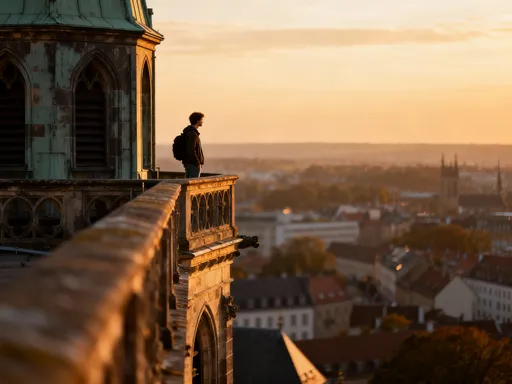
Arriving in London, one is immediately struck by the density of its presence. The city does not announce itself with a single grand gesture but reveals itself gradually, like a book whose pages unfold with each step. The architecture is not merely background; it is the narrative. As the Underground train rises above ground into central London, passengers glimpse a skyline where ancient church spires pierce the clouds alongside reflective glass towers. This juxtaposition is not accidental—it is the essence of London. The city’s identity is shaped by centuries of rebuilding, repurposing, and reimagining, resulting in a patchwork of styles that coexist in dynamic tension.
Begin in the City of London, the historic heart of the financial district, where narrow cobblestone alleys twist between towering modern offices. Here, the past is not buried but embedded. Look down at your feet and you’ll see centuries-old paving stones worn smooth by generations of footsteps. Look up, and a 17th-century church dome might peek over a glass facade. The ironwork on gates and lampposts bears intricate scrollwork, each flourish a nod to craftsmanship long before mass production. In Southwark, just across the Thames, the atmosphere shifts—brick warehouses with arched windows line cobbled streets, some converted into cozy pubs, others standing quietly, their facades telling stories of trade and toil.
Architectural awareness transforms a simple visit into a deeper, more personal experience. When travelers learn to see beyond the postcard sights, they begin to read the city like a map of human endeavor. A weathered stone carving of a gargoyle isn’t just decoration; it’s a remnant of medieval beliefs in protection and symbolism. A row of Georgian townhouses with perfectly aligned sash windows speaks to an era of order, proportion, and social hierarchy. These details, often overlooked, invite curiosity and connection. They ground us in time and place, reminding us that cities are not static but living, breathing entities shaped by those who came before.
To walk through London with attention is to engage in slow travel at its finest. It encourages pauses, second glances, and unplanned detours. A side street may lead to a quiet courtyard where time seems to stand still, or a narrow passage might open onto a view of St. Paul’s Cathedral framed perfectly between modern buildings. This kind of exploration fosters mindfulness, pulling travelers out of the rush of itinerary-driven tourism and into a more reflective, sensory-rich experience. The city rewards those who look up, who notice the texture of a wall, the curve of a staircase, or the play of light on a bronze door handle.
Gothic Grandeur: When Stone Tells Stories
No discussion of London’s architecture is complete without acknowledging the enduring power of Gothic design. This style, born in the Middle Ages and revived in the 19th century, remains one of the city’s most defining visual languages. At the heart of this legacy stands Westminster Abbey, a masterpiece of pointed arches, ribbed vaults, and flying buttresses. Every element serves both structural and symbolic purposes. The soaring ceilings draw the eye upward, evoking a sense of the divine, while the intricate stonework—carved with biblical scenes and royal emblems—tells stories of faith, monarchy, and national identity.
Inside the Abbey, the atmosphere is hushed, reverent. Sunlight filters through stained glass windows, casting kaleidoscopic patterns on the stone floor. The colors shift with the time of day, turning deep crimson in the morning and soft gold by late afternoon. The acoustics amplify even the quietest whisper, making the space feel alive with memory. Visitors walk the same aisles where monarchs have been crowned for nearly a thousand years, where poets and scientists are buried in Poets’ Corner, and where royal weddings have unfolded before global audiences. The building is not just a church; it is a living archive of British history.
Nearby, the Houses of Parliament—officially the Palace of Westminster—echo the Abbey’s grandeur. Rebuilt after the fire of 1834, the structure is a prime example of Gothic Revival architecture, championed by architects like Charles Barry and Augustus Pugin. The clock tower, commonly known as Big Ben (though technically the name refers to the bell inside), dominates the skyline with its ornate stonework and elegant proportions. The building’s exterior is rich with detail: carved gargoyles, heraldic shields, and delicate tracery in the windows. At night, when illuminated, it appears almost ethereal, a glowing symbol of democracy and tradition.
What makes Gothic architecture so compelling is its ability to inspire awe through craftsmanship and symbolism. The flying buttresses, for instance, were not just engineering solutions to support tall walls—they were visual representations of divine support, as if heaven itself held up the structure. The pointed arches, reaching skyward, reflect a spiritual aspiration. Even the way light enters the space is carefully calculated to create a transcendent experience. These buildings were designed to impress, to educate, and to elevate the soul. Today, they continue to do so, not only for worshippers and lawmakers but for millions of visitors who stand in silent wonder beneath their vaulted ceilings.
Modern Marvels: Glass, Steel, and Sky-High Design
If Gothic architecture reaches for the heavens, London’s modern skyline aims for the clouds—literally. In recent decades, the city has welcomed a new generation of skyscrapers that redefine its silhouette. These towers of glass and steel are not just feats of engineering but bold statements about progress, sustainability, and global ambition. Among them, The Shard stands tallest—both physically and symbolically. Designed by Renzo Piano and completed in 2012, this 95-story pyramid of glass rises like a shard of ice above London Bridge Station. Its reflective surface changes with the weather, mirroring the sky, the Thames, and the city around it. From a distance, it appears almost weightless; up close, its scale is overwhelming.
The Shard is more than a landmark; it is a vertical city. Inside, it houses offices, a luxury hotel, restaurants, and residential apartments. But its most popular feature is the View from The Shard, a panoramic observation deck on the upper floors. From here, visitors can see up to 40 miles on a clear day, taking in landmarks like the Tower Bridge, the London Eye, and the sprawling greenery of Hyde Park. The experience is both exhilarating and humbling—a reminder of how small we are within the vast urban landscape. What sets The Shard apart is not just its height but its design philosophy: it was intended to complement, not compete with, the historic skyline. Its tapering form reduces visual bulk, and its glass façade minimizes reflection on surrounding buildings.
Other modern icons include 20 Fenchurch Street, affectionately dubbed the “Walkie Talkie” for its distinctive shape. This building sparked controversy during construction when its curved glass surface focused sunlight so intensely that it melted parts of a parked car—a phenomenon nicknamed the “Walkie Scorchie.” Since then, sun shades have been installed, but the building remains a talking point. It also features the Sky Garden, a public space on the top floors offering free access to stunning views, indoor gardens, and a café. Unlike many skyscrapers that restrict access, the Sky Garden invites Londoners and tourists alike to experience the city from above, fostering a sense of shared ownership of the skyline.
Equally iconic is 30 St Mary Axe, better known as the Gherkin. Completed in 2003, this sleek, pickle-shaped tower was one of the first eco-friendly skyscrapers in London. Its aerodynamic form reduces wind resistance, and its double-glazed façade allows natural ventilation, cutting energy use significantly. The building’s interior spirals upward, promoting interaction and light flow. At night, it glows like a lantern, a beacon of sustainable design. Together, these modern structures demonstrate how innovation can coexist with heritage. They do not erase the past but add new chapters to London’s architectural story—chapters written in glass, light, and forward-thinking design.
Hidden Courtyards and Forgotten Corners: London’s Secret Architecture
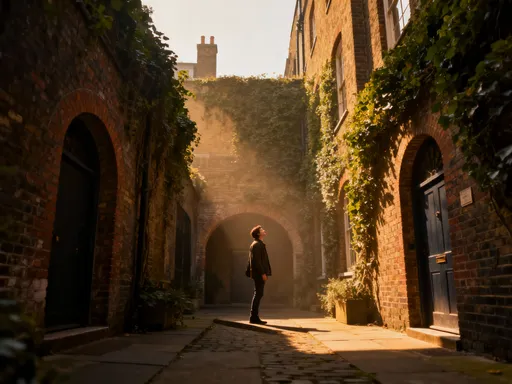
While the grand landmarks draw crowds, some of London’s most enchanting architectural moments lie in plain sight—hidden in alleys, tucked behind unassuming doors, or nestled between modern buildings. These are the city’s secret courtyards and forgotten corners, where time seems to slow and history feels tangible. One need not travel far to find them. In the City of London, a short walk from the Bank Underground station leads to Postman’s Park, a quiet green space with a poignant memorial of ceramic tiles honoring ordinary people who died saving others. Nearby, St. Bartholomew-the-Great, one of the oldest churches in London, stands half-hidden behind buildings, its 12th-century stonework a contrast to the bustling streets outside.
Equally captivating are the Wren churches—over 50 designed by Sir Christopher Wren after the Great Fire of 1666. Though many were lost in the Blitz, several remain, each a masterpiece of proportion and detail. St. Stephen Walbrook, for example, features a serene dome inspired by St. Paul’s Cathedral but on a more intimate scale. Inside, the light falls softly, creating a meditative atmosphere. These churches were not just places of worship but community anchors, designed to be visible from afar and accessible to all. Today, they serve as quiet refuges in a fast-paced city, their presence a reminder of resilience and renewal.
Victorian arcades offer another layer of hidden charm. Leadenhall Market, dating back to the 14th century but rebuilt in 1881, is a covered marketplace with a soaring glass roof, ornate ironwork, and cobblestone floors. Its arched entrances and decorative tiles evoke a bygone era of commerce and craftsmanship. Fans of film might recognize it as a filming location for the Harry Potter series, but its magic is real and enduring. Similarly, the Burlington Arcade and the Royal Arcade preserve the elegance of 19th-century shopping, with uniform shop fronts and strict rules about conduct—no hawkers, no loud behavior—maintaining a sense of refinement.
Exploring these spaces requires a shift in pace. They are not found by following a map but by wandering without urgency, by noticing a narrow passage that beckons, or a door slightly ajar. In Clerkenwell, an area rich with architectural history, one can stumble upon hidden cloisters, medieval crypts, and quiet gardens once part of monasteries. The joy of discovery lies in the contrast: stepping off a noisy street into a silent courtyard where ivy climbs ancient walls and pigeons flutter above. These moments are not just visually rewarding but emotionally grounding. They remind us that beauty and history are not always on display—they are often waiting to be noticed, quietly enduring amidst the rush of modern life.
East London Reinvented: From Factories to Trendy Lofts
Travel east of the City, and London’s architectural story takes a different turn—one of reinvention and creativity. Neighborhoods like Shoreditch, Hackney, and Bethnal Green were once centers of industry, filled with brick factories, warehouses, and railway yards. By the late 20th century, many of these buildings had fallen into disrepair, symbols of economic decline. But in recent decades, they have undergone a remarkable transformation. Artists, designers, and entrepreneurs saw potential in their raw spaces—high ceilings, exposed brick, and steel beams—and began converting them into lofts, studios, galleries, and cafes.
The result is a vibrant architectural blend where industrial heritage meets contemporary design. A former textile mill might now house a co-working space with polished concrete floors and hanging filament bulbs, its original timber beams left exposed as a nod to its past. Brewery buildings have become microbreweries again, this time serving craft beer to young professionals. Old printing presses now host pop-up art exhibitions. The aesthetic is deliberately unfinished—brick walls are left unpainted, ductwork is visible, and large windows flood interiors with natural light. This style, often called “industrial chic,” values authenticity and character over perfection.
This architectural shift reflects a broader cultural movement. East London has become synonymous with creativity, innovation, and alternative lifestyles. Street art covers building exteriors, from Banksy’s stencils to large-scale murals that change with the seasons. Markets like Brick Lane and Columbia Road Flower Market thrive in repurposed spaces, offering everything from vintage clothing to handmade ceramics. The architecture supports this energy—flexible, adaptive, and open to change. It’s a stark contrast to the rigid formality of the West End or the financial precision of the City.
What makes this reinvention so powerful is its accessibility. Unlike grand palaces or corporate towers, these spaces feel lived-in, human-scaled. You can walk into a converted warehouse and sip coffee in a space that once echoed with the sound of machinery. You can attend a jazz night in a former factory, surrounded by art and conversation. This adaptive reuse is not just about aesthetics; it’s about sustainability. By preserving existing structures, London reduces waste, honors its history, and creates unique environments that mass-built developments cannot replicate. It’s a model of urban renewal that values memory as much as modernity.
Royal Elegance and Timeless Symmetry: The Palaces and Mansions
At the opposite end of the spectrum from East London’s grit lies the refined world of royal and aristocratic architecture. Buckingham Palace, Kensington Palace, and the grand townhouses of Belgravia and Mayfair embody centuries of classical design principles—symmetry, proportion, and restraint. These buildings were not just homes; they were statements of power, wealth, and taste. Their facades are meticulously manicured, their windows aligned with mathematical precision, their entrances framed by columns and pediments inspired by ancient Greece and Rome.
Buckingham Palace, the monarch’s official residence, is a prime example. Though the original structure dates to the 18th century, it was expanded and redesigned in the 19th century to reflect the grandeur of the British Empire. The exterior is austere by palace standards—yellow brick, wrought-iron gates, and a balcony where the royal family appears during celebrations. But its scale and symmetry convey authority. Inside, the State Rooms are a showcase of opulence: gilded ceilings, crystal chandeliers, and priceless artworks. The architecture here is designed to impress, to create a sense of awe in visitors and dignitaries alike.
Equally significant are the Georgian and Victorian townhouses that line London’s garden squares. With their white-painted stucco, black railings, and fanlight windows above the door, these homes exude elegance. They were built for the upper class, with strict architectural codes ensuring uniformity and order. A row of such houses creates a streetscape that feels harmonious, almost musical in its rhythm. Many have been converted into embassies, private clubs, or luxury apartments, but their exteriors remain protected by conservation laws, preserving the city’s historical character.
This architectural style reflects a social order that once defined London. Design was not just about beauty but about signaling status. A grand entrance, a tall window, or a coat of arms above the door communicated wealth and lineage. Today, while the social hierarchies have evolved, the buildings remain as cultural landmarks. They remind us that architecture is never neutral—it carries values, histories, and identities. To walk through these neighborhoods is to step into a world where order and tradition still hold sway, where beauty is found in balance and restraint.
Why Architecture Matters: Travel That Goes Beyond the Surface
Ultimately, architecture is more than bricks and mortar—it is the silent narrator of a city’s soul. To travel with an eye for design is to engage with London on a deeper level, to move beyond checklists and selfies and into a conversation with history, culture, and human aspiration. Every building tells a story: of survival after fire and war, of innovation in materials and engineering, of shifting values from monarchy to democracy, from industry to creativity.
Noticing architecture changes the way we move through a city. It encourages us to look up, to pause, to wonder. It transforms a walk from point A to point B into a journey of discovery. A child might point at a gargoyle; a student might sketch a dome; a retiree might sit on a bench, tracing the shadow of a spire as the sun moves across the sky. These moments of connection are what make travel meaningful.
Architecture also teaches us about resilience and adaptation. London has been rebuilt many times—after the Great Fire, the Blitz, economic shifts—and each time, it has emerged with a richer, more complex identity. The city does not reject the old for the new but weaves them together, creating a tapestry that is constantly evolving. This lesson extends beyond buildings: it speaks to the human capacity to endure, to innovate, and to find beauty in transformation.
So the next time you visit London, leave the GPS behind. Let curiosity guide you. Wander down alleys, peek through gates, and take the long way around just to see what’s there. Let the city reveal itself not in monuments alone, but in the curve of a staircase, the pattern of a tile, the way light falls through a stained-glass window. Look beyond the surface. Read the walls. Listen to the stones. Because London’s true magic isn’t just in its famous landmarks—it’s in the quiet details, the hidden courtyards, the centuries of stories written in brick and glass, waiting to be seen.